Master's Project - Learnable quantisation through paramaterised companding functions.
Investigating non-standard representations in ultra low precision neural networks.
This project was conducted as part of my Master’s degree at Imperial College London. The project was supervised by Dr. George Constantinides. I self-proposed this project after reading various papers in the field of hardware for machine learning. My aim was to implement a trainable quantisation scheme optimised for LUT-based neural networks. The project was conducted over my fourth year at university was completed in 2024. The following is the abstract of the project.
You can access my full master’s thesis here.
Abstract
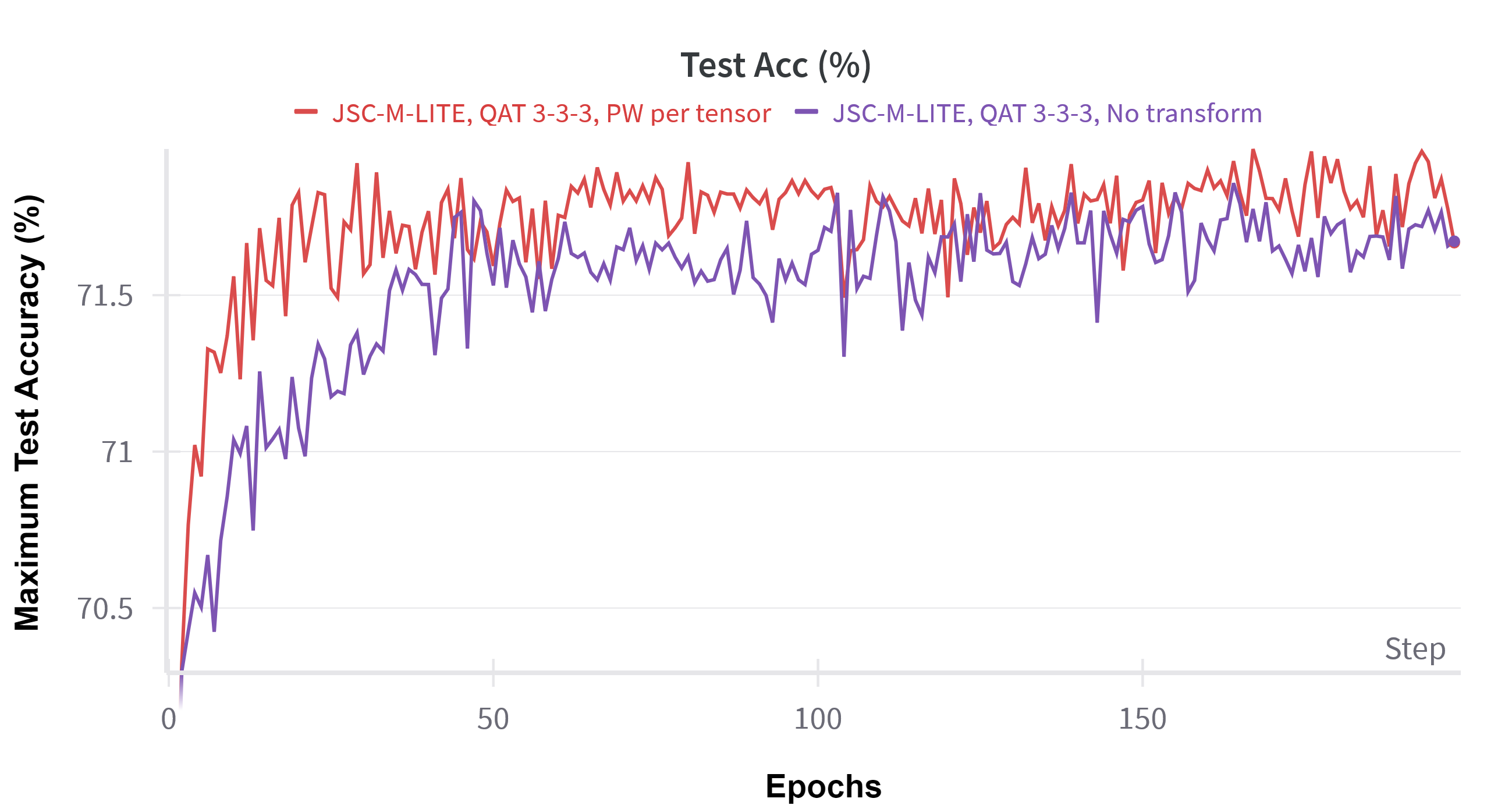
Neural networks have become integral to numerous computational tasks, yet their substantial re- source demands pose significant challenges. Quantisation techniques have shown promise in reduc- ing the computational load during neural network inference. However, the efficiency of these tech- niques is often constrained by the necessity for uniform quantisation, in order to facilitate efficient arithmetic particularly when deployed onto GPUs. PolyLUT, a novel lookup table (LUT)-based neural network deployment strategy, offers a solution by encapsulating neurons into input-output bit mappings, thereby mitigating the costs associated with non-standard data-type conversions and arithmetic. This project investigates the application of non-standard data representations within PolyLUT, focusing on parameterised non-uniform quantisation schemes that enable data representation learning. The findings show that learned non-uniform quantisation can improve network performance such that test accuracy is higher than uniformly quantised networks with larger bit-widths. Therefore, networks can be deployed with lower bit-widths with no accuracy loss, resulting in significant resource reductions. In some cases resources were reduced by a factor of two with no accuracy loss.